

In Maldives atolls most islands are in the eastern rim, where the islands are also larger and aligned in the north-south direction. For this reason the domestic airports are also in the eastern rim in a north-south direction.
Subscribe To

 Posts
All Comments
Posts
All Comments
Friday, September 4, 2020


Tuesday, September 29, 2015
Maldivian Attire over the Ages
By Dr. Abdullah Waheed,
During the days of the economic hardship of the Second World War, the traditional clothing of women became unaffordable and an alternative sought (Nadheem, 2014). Under the leadership of Mohammed Amin, the National Language and Linguistics Committee organized a series of debates, the most vibrant of which was that on the question whether the most appropriate attire for Maldivian women was the traditional garb consisting of Dhivehi hedhun, boavalhu libaas, feyli and ruma, or the newly introduced dress, faaskuri hedhun (Naseem, 2012).
During the 850 years of written Maldivian history, the attire of both men
and women have evolved, at first slowly, then more rapidly in recent period.
The earliest records of Dhivehi attire were the memoirs of Ibn Batuta, who visited
the Maldives during 1354-55. At that time Maldivian women went about with their
upper body uncovered (Nadheem, 2014).
Those days, men’s attire consisted of foshaa and feyli (see
glossary below for the meaning of these words).
 |
|
A Maldivian man and girl and man (Pyrard, early 17th
Century)
|
During the next stage, the men started wearing mundu and ganjufaras.
The women started wearing libaas or long dresses with ornamental wide
necks. Even then, girls under 15 did not cover their chests. Dresses covering
the chest was initiated in a special ceremony when a girl reached the age of
puberty (Nadheem, 2014).
During the 20th century, when the Maldives began to be exposed
to the outside of the world, new ways of dressing began to come in. To the
men’s fashion came aygudhu libaas, and shirts. In 1968, trousers became
compulsory office wear. Women started wearing faaskuri hedhun.
At the end of 20th century, buruga made its appearance and
dominated women’s fashion. Even face veils appeared on the scene. In the
opposite direction one could also observe ‘fashion buruga.’
The Early Times
When Ibn Batuta visited the
Maldives in the period 1354 to 1355, the men’s clothing was a waist
wrapper; they bound this round their middle instead of the trousers and put
round their shoulders an article of clothing called wilyan
(a foshaa?). Some put on a turban, while others wore a small kerchief.
The women did not cover their heads, nor did the queen. Most of them wore only a waist-wrapper, which
covered them from their waist to the lowest part, but the remainder of their
body remained uncovered. Thus they walk about in the bazaars and elsewhere (Mahdi
Husain, 1976).
Francois Pyrard de Laval (1611) who visited the Maldives at the turn of the 16th century described the attire of Maldives in the following words: “First, the men bind all round their private parts with a broad band of cloth…. Over this they wear a small cotton cloth, dyed blue or red or some other color, reaching only as far as the knees. Above this they wear a large cloth of cotton, or silk, if they be at all rich and well off; this reaches to the ankles, and is belted with a fine square kerchief, embroidered with gold and silk; this is folded in three, drawn round the loins, and tied in front. Then, for braver adornment, they add a little piece of silk of various colors, fine as crape or gauze, and short, not reaching further than the mid-thigh; and after all this they gird themselves with a large silken sash, like their turbans, with pretty fringes, the ends whereof they let hang down in front. The rest of the body from the waist upwards is left naked - I mean by the common folk; for the gentlemen of quality do not so; and yet on festival days they put on their doublets and gowns of cotton or silk, fastened with buttons of gilded copper. All wear on their heads turbans of red, or chequered of various colors.
“As for the women, first of all they have a large colored cloth of cotton or silk, which covers them from the waist to the ankles, and serves as a petticoat. Above this they wear a robe of taffetas, or of very fine cotton, but very long, reaching to the feet, and with blue and white borders. To give a notion of its shape, I cannot better describe this robe than by comparing it to the chemises which the women wear here in France (Francois Pyrard de Laval, 1611).”
Francois Pyrard de Laval (1611) who visited the Maldives at the turn of the 16th century described the attire of Maldives in the following words: “First, the men bind all round their private parts with a broad band of cloth…. Over this they wear a small cotton cloth, dyed blue or red or some other color, reaching only as far as the knees. Above this they wear a large cloth of cotton, or silk, if they be at all rich and well off; this reaches to the ankles, and is belted with a fine square kerchief, embroidered with gold and silk; this is folded in three, drawn round the loins, and tied in front. Then, for braver adornment, they add a little piece of silk of various colors, fine as crape or gauze, and short, not reaching further than the mid-thigh; and after all this they gird themselves with a large silken sash, like their turbans, with pretty fringes, the ends whereof they let hang down in front. The rest of the body from the waist upwards is left naked - I mean by the common folk; for the gentlemen of quality do not so; and yet on festival days they put on their doublets and gowns of cotton or silk, fastened with buttons of gilded copper. All wear on their heads turbans of red, or chequered of various colors.
 |
| A Maldivian woman, (Pyrard, early 17th Century) |
“As for the women, first of all they have a large colored cloth of cotton or silk, which covers them from the waist to the ankles, and serves as a petticoat. Above this they wear a robe of taffetas, or of very fine cotton, but very long, reaching to the feet, and with blue and white borders. To give a notion of its shape, I cannot better describe this robe than by comparing it to the chemises which the women wear here in France (Francois Pyrard de Laval, 1611).”
Modern Times
During the 1830s, the ordinary dress of Maldivian men consisted of short drawers with a cloth wrapped round the waist, and another about the head, the waistcloth being twisted into a knot in the front, which is supported by a string encircling the loins. The nobles wore, in addition, an embroidered sash of silk or cotton about the waist, and on Fridays when attending the grand mosque, a kind of shirt (white) reaching to the ankles, with a turban of the same color. The women's habiliments consisted merely of a cloth wrapped round the waist, descending to the knees, which was secured by a string, and a long shirt; also a cloth tied round the head (Young and Christopher, 1836).
During the 1830s, the ordinary dress of Maldivian men consisted of short drawers with a cloth wrapped round the waist, and another about the head, the waistcloth being twisted into a knot in the front, which is supported by a string encircling the loins. The nobles wore, in addition, an embroidered sash of silk or cotton about the waist, and on Fridays when attending the grand mosque, a kind of shirt (white) reaching to the ankles, with a turban of the same color. The women's habiliments consisted merely of a cloth wrapped round the waist, descending to the knees, which was secured by a string, and a long shirt; also a cloth tied round the head (Young and Christopher, 1836).
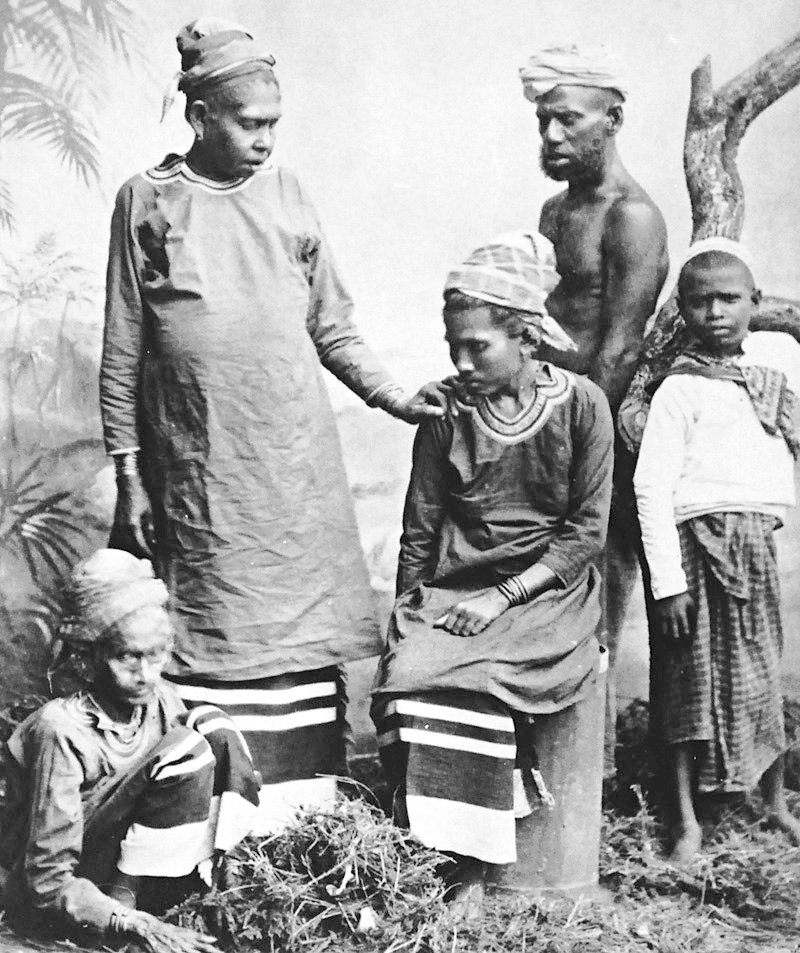 |
| An extended Maldivian family (Rosset, 1885) |
CW Rosett
visited the Maldives in 1885 and left a rich collection of photographs and illustrations
depicting Maldivian attire. Those days the ordinary dress of the men consisted
of drawers, a cloth bound round the loins, after the mode of the Singhalese,
and a handkerchief twisted round the head. On special days, such as Fridays,
when they attended the mosque, the high caste wore a shirt and jacket, over
which was a kind of long dressing down, coming down and nearly to the feet. The
turban was only worn by priests and the sultan.
 |
| A Maldivian family (Rosset, 1885) |
The women wore round their waist
a cloth (mostly of native manufacture), coarse in texture, of a dark chocolate
color, with a border of parallel black and white stripes. It reached down to the ankles. Over this they wore
a kind of loose shirt, or gown, of silk, with short sleeves, reaching nearly to
the knees; the openings for the neck and arms were ornamented with embroidery
in gold, silver, and silk thread (Carl Wilhelm Rosett, 1887).
During the days of the economic hardship of the Second World War, the traditional clothing of women became unaffordable and an alternative sought (Nadheem, 2014). Under the leadership of Mohammed Amin, the National Language and Linguistics Committee organized a series of debates, the most vibrant of which was that on the question whether the most appropriate attire for Maldivian women was the traditional garb consisting of Dhivehi hedhun, boavalhu libaas, feyli and ruma, or the newly introduced dress, faaskuri hedhun (Naseem, 2012).
 |
| A young girl (Rosset, 1885) |
According to Dhivehi Wikipedia permission was granted in 1942 to wear faaskuri
hedhun (number hedhun) instead of the traditional garb of
women. Following this change, the art of
weaving cloth declined and by the late 1940s, it almost disappeared. To revive
the art an expert was brought and a batch of students was sent abroad to learn
cloth weaving (Liyuntherin ge Gulhun, 2014).
 |
| Women in faaskuri hedhun alongside expat teachers (1960) |
Even as late the 1990s, burugaa, the Muslim women’s headgear, was rare in
the Maldives. However starting 2000, with freedom given to scholars to preach,
burugaa became widespread with 100% adherence in some islands. However, because
of the very fast spread, the so called fashion burugaa also appeared on the
scene (Dhivehi Mujuthamau, 2008).
The Present Situation
 |
| Black robe and buruga, quite popular during the current era |
When the Maldives began to open to the outside world, new fashions were
introduced. This included western attire as well as Islamic dresses. An
important landmark of this trend was the emergence of trousers as compulsory office
wear for men and an appropriate western or Indian dress for women along with
matching footwear. During the 1980s buruga was made a compulsory part of the
uniform for the Islamic school, Mauhadh (later Arabiyya.) From these schools buruga spread to the
community at large in the 1990s. By 2000 buruga was part of the dress for
nearly all women.
 |
| Fashion buruga, quite popular during the current era |
With such fast spread, not all those who wore buruga adhered to the
etiquette that went along with the buruga. As a result the so-called fashion
buruga appeared. With such buruga, though the hair was covered, the rest of the
body was engulfed in body hugging dresses and jeans, leaving very little to
imagination. What we see on the road
today a mix of all these trends.
Glossary:
Aygudhu libaas = A long sleeved shirt with large collars
Boavalhu = Embroidered wide border along the neck of a dress
Buruga = A Muslim woman’s head covering
Faaskuri hedhun = A long gown introduced in the 1940s as a dress for
women.
Feyli = A woman’s sarong, usually with black and white lines along the lower
border.
Foshaa = A white cloth covering the body
Ganjufaras = A white T-shirt like dress worn by men, often made of
thin white cloth.
Hedhun = Dress
Khatib = Preacher
Libaas = A type of long dress
Mundu = Sarong of the type worn in south India, covering the lower body
Ruma = A square piece of cloth usually starched, folded and fixed on a woman’s
knot of hair.
Qazi = Judge
References:
1.
Ahmed
Nadheem (2014), Eyraai Mihaaruge Dhivehin: Hedhun Elhun, Haveeru Daily,
retrieved 27 Sep 2015 from
http://www.haveeru.com.mv/dhivehi/report/149566
http://www.haveeru.com.mv/dhivehi/report/149566
2.
Mahdi
Husain (1976) The Rehla of Ibn Battuta - India, Maldive
Islands and Ceylon, Chapter 16, English translation, Oriental Institute, Baroda, India, Retrieved
22 Sep 2015 from http://www.maldivesculture.com/index.php?option=com_content&task=view&id=198&Itemid=74
3.
Francois
Pyrard de Laval (1611), The Voyage of Francois Pyrard of Laval to the East
Indies, the Maldives, the Moluccas and Brazil,
Vol.1 Chapter 13, translated into English by Albert Gray assisted by
H.C.P. Bell, retrieved 22 Sep 2015 from < http://www.maldivesculture.com/index.php?option=com_content&task=view&id=179&Itemid=75>
4.
I.
A. Young and Mr. W. Christopher (1836), Memoir on the Inhabitants of the
Maldiva Islands 1834-1835 - pt.1, pp.54-86, 'Transactions of the Bombay
Geographical Society from 1836 to 1838', retrieved 23 Sep 2015 from http://www.maldivesculture.com/index.php?option=com_content&task=view&id=170&Itemid=77
5.
Carl
Wilhelm Rosset (1887), Carl Rosset in Male', Maldives 1885, Illustrierte
Zeitung, retrieved 23 Sep 2015 from http://www.maldivesculture.com/index.php?option=com_content&task=view&id=241&Itemid=77
6.
Ahmed
Naseem (2012), Sumuvvul Amir Mohammed Amin Dhoshimeyna Kilegefaanu, Dhiyavaru, Retrieved
22 Sep 2015 from http://ahmednasym.blogspot.com/2012/09/blog-post_9.html
7.
Wikipedia
Dhivehi (), retrieved 27 Sep 2015 from
https://dv.wikipedia.org/wiki/%DE%89%DE%AC%DE%87%DE%A8_12
https://dv.wikipedia.org/wiki/%DE%89%DE%AC%DE%87%DE%A8_12
8.
Morning Post (2014) Dhivehi Raajjeygai feyraan viyan molhah dhaskurumah
vihi kudhin India ah, Liyuntherin ge Gulhun, retried 22 Sep 2015 from http://www.liyuntherin.org/index.php?option=com_content&task=view&id=1913&Itemid=17
9.
Dhivehi
Mujuthamau (2008), Dhivehi anhenun burugaa alhaigen oriyaamun, retrieved 27 Sep
2015 from http://dhivehimujthamau.blogspot.com/2008/06/blog-post.html
Subscribe to:
Posts (Atom)